
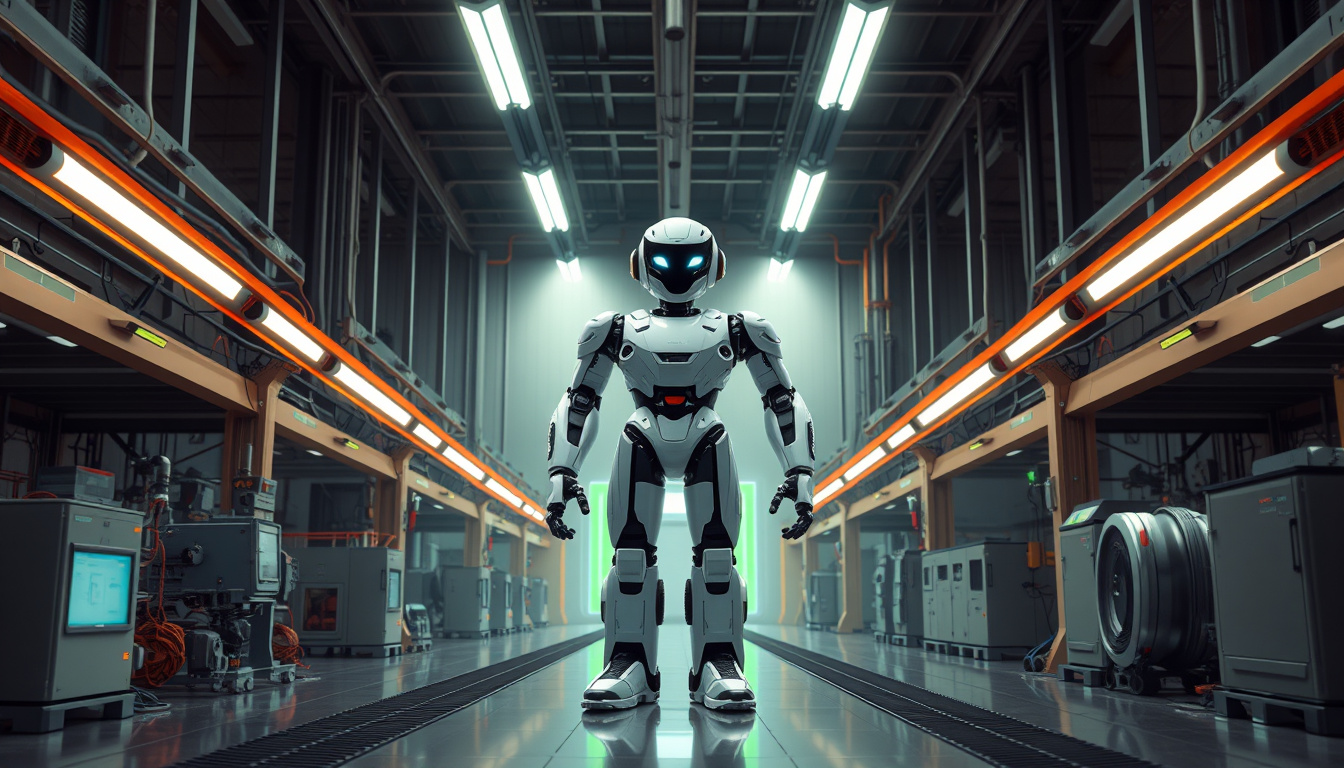
Egypt is taking a transformative step in its manufacturing landscape by unveiling the country’s first locally developed industrial robot.
Launched on September 23, this innovative initiative is a collaborative effort between RaedBots, the Industrial Modernization Center (IMC), and CUBII Industrial Solutions.
With a focus on enhancing local production capabilities and advancing technological infrastructure, the new industrial robot stands as a significant milestone in Egypt’s commitment to modern manufacturing.
Distinguished by its 80 percent local content rate, which is expected to hit 90 percent when the primary motor shifts to domestic production, this robot is not merely a demonstration piece—it is designed with real-world industrial applications in mind.
CUBII, which specializes in automated food filling and packaging systems, is set to integrate this robot into its current manufacturing processes, thereby enriching its capabilities and extending its operations beyond Egyptian borders.
This initiative not only aims to modernize the manufacturing sector but also plays a crucial role in reducing dependency on imported automation systems, paving the way for a self-sufficient and robust manufacturing industry in Egypt.
Key Takeaways
- Egypt has launched its first locally developed industrial robot, marking a significant step towards enhancing local production capabilities.
- The robot boasts an 80 percent local content rate, with plans to increase it to 90 percent as Egypt aims to reduce reliance on imported automation.
- This initiative aligns with Egypt’s strategy to boost its industrial sector’s contribution to GDP, targeting an increase from 14% to 20% by
2030.
Development of the Locally Made Industrial Robot
The recent introduction of Egypt’s first locally developed industrial robot marks a significant milestone in the country’s technological progress and manufacturing capabilities.
Developed by RaedBots, a forward-thinking Egyptian technology firm, in collaboration with the Industrial Modernization Center (IMC) and CUBII Industrial Solutions, this initiative is part of a concerted effort to enhance local production systems.
Officially launched on September 23, the robot is not merely a prototype but a fully operational piece of technology designed for real industrial applications, boasting an impressive 80 percent local content.
This percentage is forecasted to reach 90 percent with the planned domestic production of its main motor, highlighting Egypt’s commitment to self-sufficiency in industrial automation.
CUBII, known for its automated food-filling and packaging solutions, plans to integrate the new robot into its systems, enabling its products to be tested in international markets as they are already exported globally.
The performance of the robot will be closely monitored by the Ministry of Industry to ensure it meets the necessary production standards.
The shift towards locally developed automation technology could significantly reduce Egypt’s historical reliance on imported systems.
Furthermore, RaedBots specializes in creating AI-driven robotic solutions applicable across various sectors, such as welding and packaging.
The initiative also includes invaluable support from Mansoura University’s Faculty of Engineering, which is slated to contribute educational robots for research and training purposes.
This robotics project is pivotal to Egypt’s broader goal of modernizing its industrial landscape, aiming to boost the sector’s contribution to the nation’s GDP from 14% to 20% by the year
2030.
Impact on Egypt’s Manufacturing Sector
The introduction of Egypt’s first locally developed industrial robot serves as a catalyst for transformation within the country’s manufacturing sector.
By harnessing local talent and resources, this initiative presents a paradigm shift from reliance on imported automation solutions to a self-sustained technological ecosystem.
The robot’s operational deployment, particularly in CUBII’s production lines, not only illustrates the practical applications of this innovation but also positions Egypt as an emerging player in the competitive landscape of global manufacturing.
With CUBII’s established export capabilities, the new robot will have the distinct advantage of being tested in diverse international markets, which is vital for its iterative improvement.
Moreover, the collaboration with educational institutions like Mansoura University fosters a symbiotic relationship between academic research and industrial application, paving the way for future advancements and workforce development.
As Egypt continues to prioritize local production through strategic initiatives, the potential for enhanced efficiency, economic growth, and technological advancement becomes increasingly viable, setting the stage for a robust industrial future.