
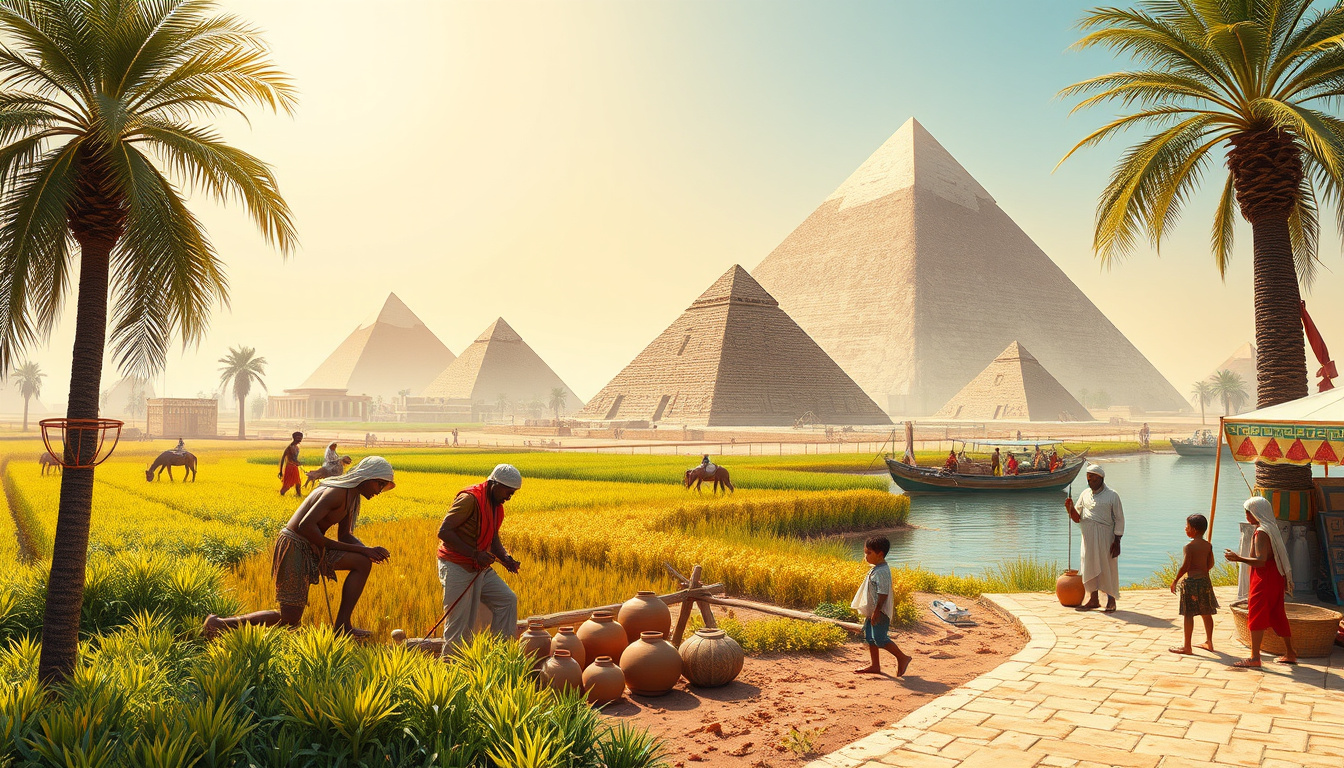
The civilization of Ancient Egypt, spanning nearly three millennia from the Bronze Age through the Imperial Roman era, remains one of the most captivating chapters in human history. While the grandeur of pyramids, temples, and royal tombs frequently dominates popular imagination, the day-to-day lives of the common people who built and sustained this remarkable society often remain in the shadows. This article embarks on a journey to explore the fabric of daily life in Ancient Egypt—the rhythms, challenges, and traditions that shaped the existence of its vast population beyond the pharaohs and elites.
The Nile: The Lifeblood of Ancient Egypt
The Ancient Egyptians referred to their land as the "gift of the Nile," a title that aptly reflects the river’s central role in their society. The Nile was much more than a waterway; it was the artery of life itself. Its predictable seasonal flooding enriched the soil, enabling extensive agricultural prosperity amid an otherwise arid desert.
The Three Seasons of the Nile and Their Impact
The life of most Egyptians was intricately tied to the Nile’s seasonal cycle, which divided the year into three distinct periods:
Akhet (Flood Season): Starting in late July, the Nile overflowed its banks, depositing nutrient-rich silt across the floodplains. During this inundation, the fields were underwater and unsuitable for farming. Instead, people engaged in repairing agricultural tools or taking part in large state-sponsored construction projects, such as building pyramids and temples.
Peret (Emergence Season): From January to May, the floodwaters receded, leaving behind fertile, thick layers of silt. This season marked the time to sow crops. Women typically sowed seeds while men plowed with the assistance of oxen or cattle. Fish were abundant due to the receding waters, providing an essential protein source, and mud bricks made from baked silt formed the basis of Egyptian housing.
Shemu (Harvest Season): Between May and September, Egyptians harvested their mature crops. With minimal rainfall, small irrigation canals required maintenance to support agriculture during this dry season.
The Nile’s annual cycle dictated not only agricultural activities but also spiritual beliefs, social organization, and economic planning.
Agriculture and Economy: The Backbone of Society
Agriculture underpinned Ancient Egyptian society. Approximately 90% of the population were peasants working the land, growing cereals such as barley and wheat— the staples of the Egyptian diet and economy. Vegetables like onions, leeks, radishes, and legumes supplemented their food, while native fruits such as figs, dates, grapes, and melons added variety. Later influences introduced almonds, peaches, and pomegranates.
Interestingly, Egypt never minted coins during most of its history. Instead, a barter system based on grain quantities was in place. The "deben," a weight measure, served as the currency equivalent—for example, a pair of sandals cost roughly the same as seventy-five liters of wheat. This system underscored the critical importance of agricultural surplus since grain represented value, food, and trade commodity.
The state played a significant role in storage and redistribution. Grain was stored in temple granaries, protected by small granary cats— an early example of pest control—and guarded carefully. Cats held profound cultural significance, simultaneously serving practical purposes and spiritual symbolism.
Daily Nutritional and Social Habits
Diet and Food Preparation
Egyptians typically ate twice daily: a breakfast at dawn and dinner in the evening. Breakfast was simple—bread, beer, and sometimes onions. Beer was a dietary staple, produced meticulously under state oversight following recipes attributed to the god Osiris. It was consumed through straws to filter sediment and was a safer alternative to water, which could be contaminated. Evening meals were more elaborate, featuring bread, beer, vegetables, fish, small birds, eggs, fruits, and desserts.
While the cuisine focused more on quantity than refinement, the daily caloric intake averaged around 3800 calories, reflecting the physical demands of Egyptian labor.
Housing and Community Life
Typical homes were constructed from mud bricks made of silt and featured small upper windows to maintain cool interiors during the hot months. Families lived in close-knit communities where cooperation was essential for survival.
State festivals and private banquets served as social glue, bringing people together to sing, dance, and celebrate shared traditions. Music was integral, with female musicians playing lutes, drums, and harps, and both male and female vocalists performing.
Social Structure and Roles
Classes and Occupations
Egyptian society was stratified but functionally interdependent:
Peasants and Laborers: Forming the vast majority, these individuals worked from dawn to dusk in agriculture, fishing, construction, and artisanal crafts. Their labor was physically demanding and hazardous, with risks from wild animals like snakes, crocodiles, and hippos.
Craftsmen and Artisans: Skilled workers such as blacksmiths, carpenters, and potters composing a middle class that crafted everyday and luxury goods.
Priests and Scribes: The literate elite who oversaw religious practices and administration. Literacy was uncommon, possessed by only 5-10% of the population, predominantly men.
Royal and Noble Families: Occupying the apex of society, including pharaohs and their court.
Gender Roles and Women’s Rights
While ancient Egypt was predominantly patriarchal, women enjoyed comparatively significant rights:
Women could own businesses, inherit property, and divorce.
They participated actively in markets and trade.
Herodotus, the Greek historian, noted ironically that women managed business while men sometimes undertook domestic tasks like weaving.
Despite expectations for women to maintain households and marriage, five female pharaohs emerged throughout Egypt’s history, notably Hatshepsut and Cleopatra, though such rulers were exceptions.
Marriage and Family Life
Marriage in ancient Egypt was a contract based on mutual agreement; elaborate rituals were less common. Courting involved the man gifting symbols of his status to the woman’s family. Weddings included vibrant banquets featuring music, dancing, and communal celebration.
Love poetry and romantic expression were prevalent, with inscriptions reflecting affectionate, enduring relationships.
Leisure and Cultural Expression
Egyptians valued leisure activities outside work. Hunting of various animals, including lions and birds, was pursued for sport and sustenance. Sports like wrestling, archery, and stick fighting were popular for both adults and children, alongside board games such as Senet and Mehen, and games of chance with dice or sticks.
Fashion and personal grooming held cultural and spiritual significance. The belief in an afterlife where the body remained intact motivated meticulous care in appearance, clothing, jewelry, and cosmetics. Accessory materials like lapis lazuli, carnelian, and gold were widespread symbols of status, while color choices communicated meanings—white indicated purity and was reserved for funerals.
Myths, Religion, and Symbolism Connected to Everyday Life
The Nile’s presence permeated Egyptian mythology, representing balance and harmony crucial for both existence and the cosmos. The sun god Ra was depicted sailing a boat across the sky, similar to how Egyptians navigated their river.
Religious festivals, temple rituals, and offerings to deities such as Bastet, the goddess of protection and fertility associated with cats, blended spiritual beliefs with daily practices. Some Egyptians purchased pre-mummified animals as votive offerings to the gods, demonstrating the intersection of commerce, religion, and tradition.
Conclusion
The everyday lives of Ancient Egyptians reveal a complex, deeply interconnected society anchored in the rhythms of the Nile. While the monuments and pharaohs capture headlines, it was the dedication, labor, and traditions of millions of ordinary people that sustained Egyptian civilization for thousands of years. Their agricultural expertise, social customs, cultural expressions, and spiritual beliefs continue to fascinate and inform our understanding of human history.
From the fertile fields to the bustling marketplaces, family homes, and celebratory banquets, the world of the Ancient Egyptian commoner enriches our insight into one of humanity’s most enduring legacies.
Frequently Asked Questions (FAQ)
1. What was the role of the Nile River in Ancient Egyptian society?
The Nile was vital for agriculture, transportation, and daily life. Its annual flooding deposited fertile silt, enabling crop cultivation in an otherwise desert landscape. It also served as a transportation highway and held deep religious significance.
2. Did slaves build the pyramids in Ancient Egypt?
Contrary to popular myth, slaves formed a small portion of the population and did not build the pyramids. Most labor was carried out by paid workers, including farmers who worked on such projects during the flood season.
3. How were women treated in Ancient Egyptian society?
Women had relatively extensive rights, including owning property, inheriting, divorcing, and engaging in trade. Though marriage and family roles were emphasized, women’s legal and economic status was more advanced than in many contemporary societies.
4. What kind of food did common Egyptians eat?
Their diet mainly included bread, beer, vegetables (such as onions and leeks), fruits, fish, eggs, and small birds. Beer and bread were staples, providing much of their caloric intake to support physically demanding labor.
5. How did Ancient Egyptians entertain themselves?
They engaged in hunting, sports like wrestling and archery, and played board games such as Senet. Music and dance played a central role during communal festivals and private celebrations.
6. Were Ancient Egyptians literate, and who could read or write?
Literacy was restricted mostly to priests, scribes, and elites—about 5-10% of the population, primarily men. The majority of Egyptians were illiterate and did manual labor or crafts.
7. How did Ancient Egyptians preserve their bodies after death?
Embalming and mummification were common, aiming to preserve the body for the afterlife. Religious beliefs mandated maintaining the body’s form, which influenced their practices in life and death.
By exploring the multifaceted aspects of daily life from the fields to the family home, this glimpse into Ancient Egypt offers a vibrant narrative beyond monumental tombs—illuminating the enduring humanity at the heart of one of history’s greatest civilizations.