
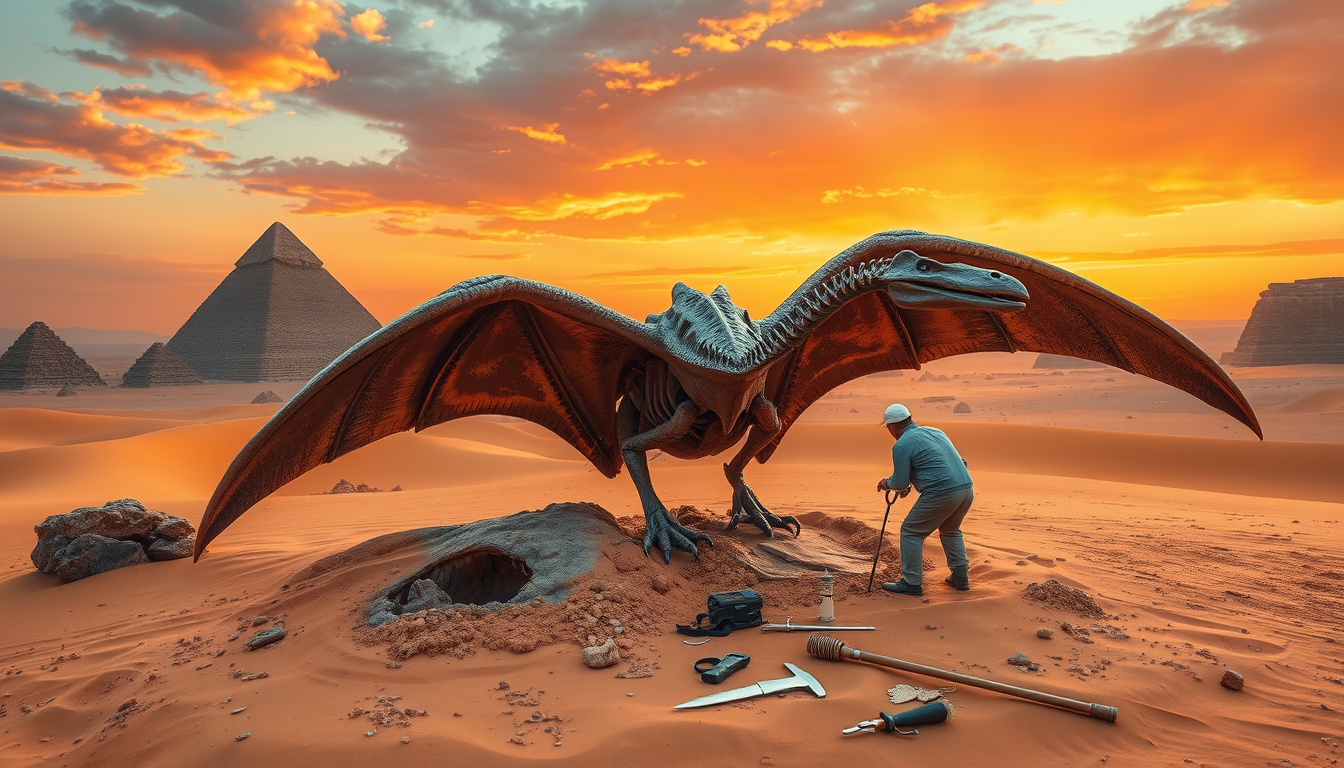
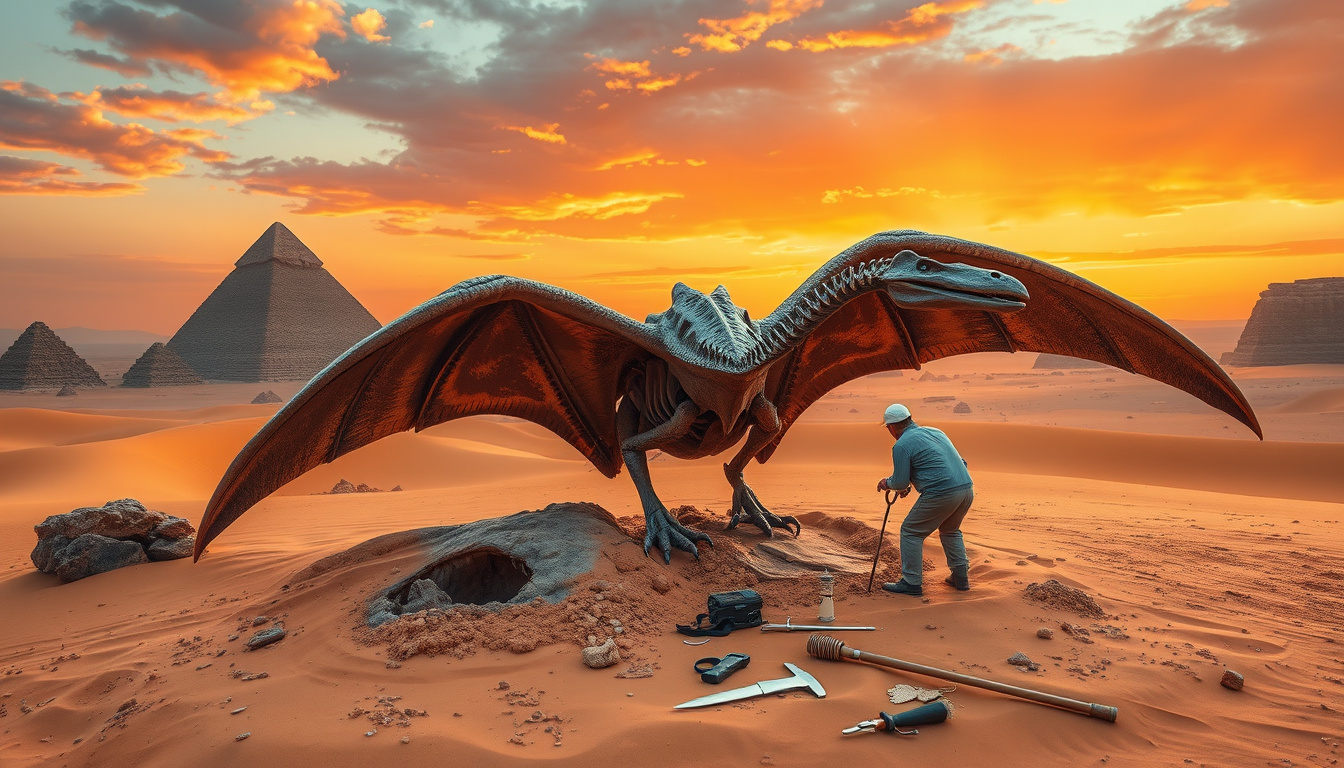
On June 30, 2026, a significant breakthrough in paleontological research took place as researchers from Mansoura University announced the discovery of Egypt’s first confirmed pterosaur fossil dating back to the Late Cretaceous period, approximately 95 million years ago.
The fossil, unearthed by the Mansoura Vertebrate Palaeontology Centre (Sallam Lab), comprises a crucial wing bone associated with the pterosaur’s extended fourth finger, found in the rich deposits of the Bahariya Formation near the Bahariya Oasis.
This discovery not only fills a critical gap in the fossil record of pterosaurs in Africa but also sheds light on the ecological history of the region during the age of dinosaurs.
Key Takeaways
- The discovery marks Egypt’s first confirmed record of pterosaurs from the Late Cretaceous period.
- The fossil, part of a pterosaur wing, provides crucial insights into ancient aerial wildlife and its evolution.
- This find enhances the understanding of the paleontological landscape in Egypt, highlighting the rarity of pterosaur fossils worldwide.
Significance of the Pterosaur Fossil Discovery
The significance of the recent pterosaur fossil discovery in Egypt cannot be overstated.
On June 30, 2026, researchers from Mansoura University unveiled the first confirmed evidence of pterosaurs in the country, dating back to the Late Cretaceous period roughly 95 million years ago.
Unearthed by the Mansoura Vertebrate Palaeontology Centre, specifically the Sallam Lab, this groundbreaking find includes a well-preserved fossil of a pterosaur wing—particularly a bone from the extended fourth finger—located in the Bahariya Formation near the Bahariya Oasis, an area renowned for its rich marine deposits.
Anatomical evaluations of the fossil suggest that this pterosaur boasted a wingspan of about four meters, indicating it was of medium size.
Notably, pterosaur bones are characteristically thin-walled and lightweight, complicating the fossilization process and explaining the scarcity of pterosaur records throughout Africa and the Arabian Peninsula.
Therefore, the discovery of this fossil holds exceptional importance for the paleontological community.
As lead author Bilal Salem emphasized, this find not only showcases a facet of aerial wildlife that existed alongside formidable terrestrial predators of the time but also enriches our understanding of pterosaur evolution and their ecological roles in prehistoric ecosystems.
These findings, recently published in the esteemed journal Acta Palaeontologica Polonica, mark a significant milestone in vertebrate paleontology and open new avenues for future research in the region.
Implications for Vertebrate Paleontology in Egypt
This groundbreaking discovery signifies a pivotal moment for vertebrate paleontology in Egypt, particularly as it sheds light on the evolutionary history of pterosaurs—flying reptiles that roamed the skies during the age of dinosaurs.
The fossil, discovered in the Bahariya Formation, indicates not only the existence of these enigmatic creatures in Egypt but also their adaptive qualities in a diverse ecosystem made up of large terrestrial predators such as dinosaurs.
The implications extend beyond mere documentation; they provide insight into the ecological dynamics of the Late Cretaceous period in Africa.
Researchers are now able to re-evaluate existing theories about pterosaur distribution and their evolutionary trajectories, as well as refine the geological timelines based on this new fossil evidence.
This discovery paves the way for further paleontological exploration in Egypt, which holds promise for revealing additional fossils that could further expand our comprehension of prehistoric life.