
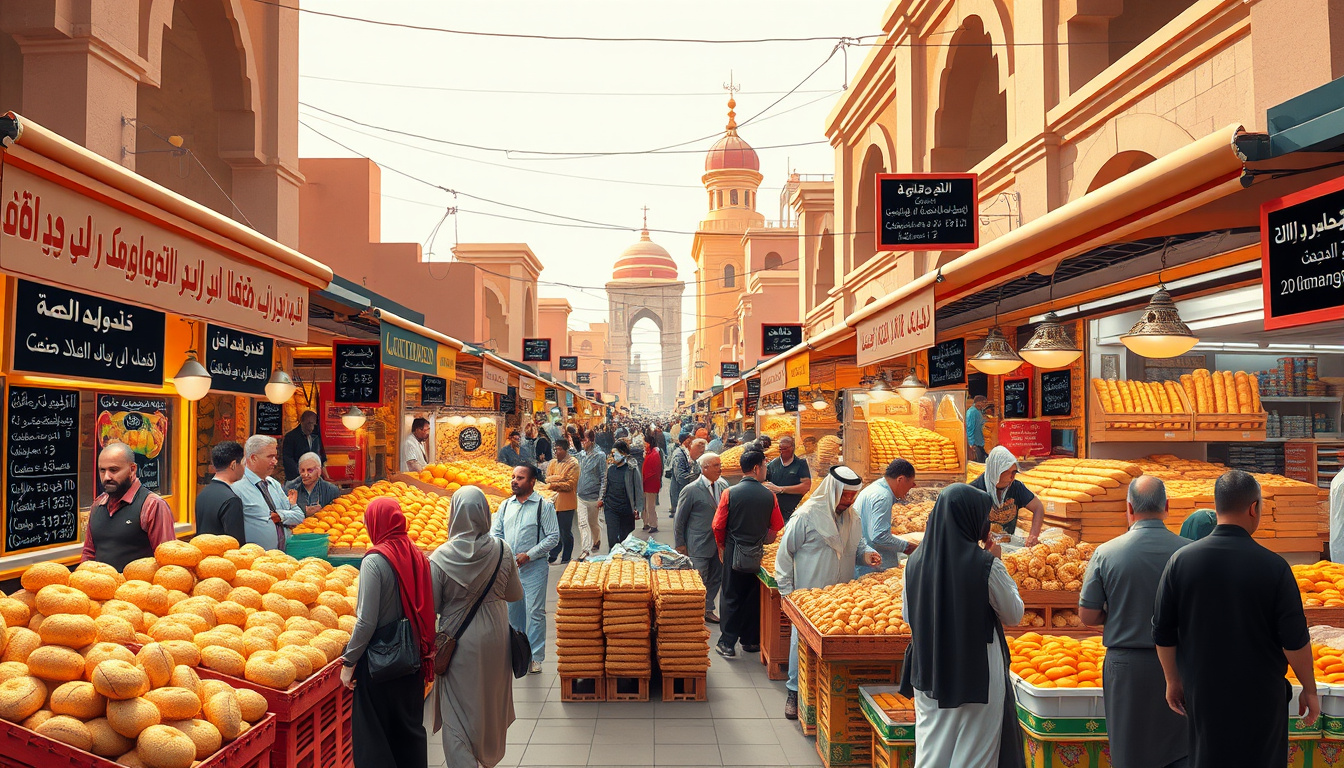
In Egypt, bread is more than just a dietary staple; it is a symbol of social stability and economic security.
The affection for bread runs deep in Egyptian culture, often referred to as the ‘staff of life’.
However, with rising inflation and economic pressures, especially following recent increases in fuel prices, maintaining the affordability of bread has become a political and social battleground.
The government has stepped in to cap prices on ‘free-market’ bread amid these changes, and the nation is witnessing a critical juncture in its history regarding food security.
In this article, we’ll delve into the historical significance of bread in Egypt, explore the current economic challenges the country faces, and discuss the government’s responses to ensure that this vital resource remains accessible to all.
Key Takeaways
- Bread is a vital staple in Egypt, deeply tied to social stability and national identity.
- Recent government price caps on bread amid rising fuel costs aim to mitigate inflation but threaten economic balance.
- Egypt’s dependence on imported wheat makes its food system vulnerable to global market fluctuations and geopolitical crises.
The Historical Significance of Bread in Egypt
Bread has long been more than mere sustenance in Egypt; it is a cornerstone of the nation’s cultural and social fabric.
The recent governmental measures to cap the price of bread—specifically, the ‘baladi’ loaf at EGP 2 (approximately USD
0.04)—reflect the ongoing struggle to manage economic turbulence exacerbated by rising fuel costs, which have surged between 10 to 17 percent.
Historically, affordable bread has been viewed not only as a vital source of nutrition but also as a fundamental right linked to social stability and national identity.
The concept of the moral economy underscores this expectation, as Egyptians have historically resisted changes to subsidy policies that threaten access to this staple food.
The security of cheap bread came into sharp relief during the infamous 1977 bread riots, showcasing the potential for social unrest when citizens feel their basic rights are undermined.
Today, Egypt faces compounded crises, including geopolitical tensions stemming from the Russia-Ukraine conflict, impacting wheat supply and thereby placing additional pressure on a food system already vulnerable due to dependence on foreign imports.
As the largest wheat importer worldwide, the Egyptian government finds itself in a precarious position, balancing the need to support the population through substantial bread subsidies against the realities of fiscal constraints.
Any adjustments to these subsidies, whether through increased prices or reduced eligibility, pose risks not only to economic stability but also to the fragile trust between the state and its citizens—a delicate equilibrium that continues to shape the socio-economic landscape of Egypt.
Current Economic Challenges and Government Responses
The economic landscape in Egypt is currently marred by an array of challenges that require urgent government response to maintain stability and public trust.
With the cost of fuel on the rise, the government has intervened by imposing price caps on bread, particularly on the traditional ‘baladi’ loaf.
This decision to stabilize prices at EGP 2 (approx.
USD
0.04) is crucial in light of inflationary pressures that threaten to exacerbate the affordability crisis for basic goods.
The concept of the moral economy plays a significant role here; the populace views access to affordable bread not only as a necessity but as an intrinsic right linked to their social rights and identity.
This underscores why recent instability in wheat supply due to the geopolitical crisis sparked by the Russia-Ukraine war adds layers of complexity to the already fragile economic situation in Egypt.
As the country grapples with external shocks and internal pressures, the government must navigate the tricky terrain of subsidy management without igniting public discontent.
Thus, the approach towards maintaining bread subsidies amid rising costs becomes a litmus test for the government’s capability to foster economic resilience while ensuring that the people’s expectations for affordable staple foods are met.