
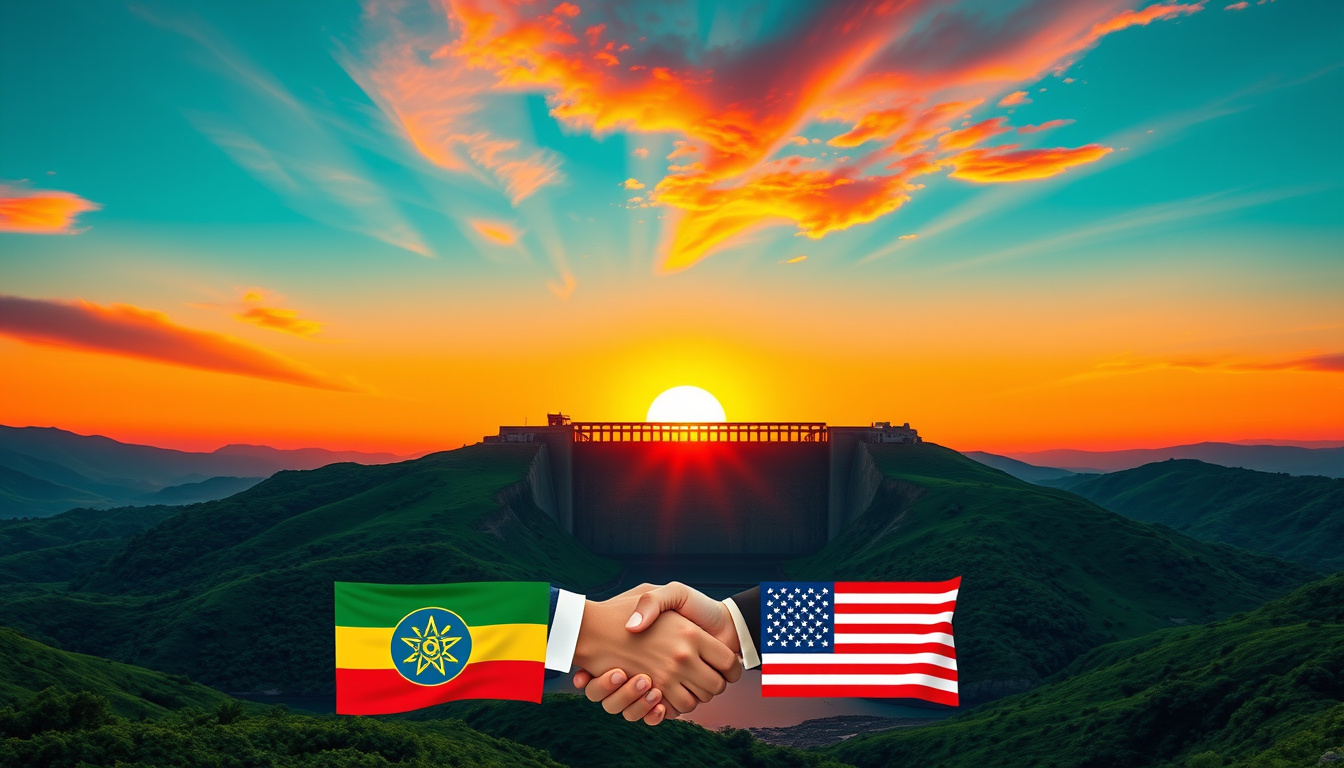
In a significant diplomatic overture, President Donald Trump has re-entered the discourse surrounding the Grand Ethiopian Renaissance Dam (GERD) by offering to resume US mediation in the protracted dispute between Ethiopia, Egypt, and Sudan.
On January 16, 2026, Trump communicated with Egyptian President Abdel-Fattah Al-Sisi, underscoring the critical importance of Nile water security for Egypt and signaling a renewed commitment to address the complex water-sharing disagreements that have escalated over the past decade.
This article will delve into the historical context of the GERD dispute and explore the potential implications of Trump’s renewed mediation efforts for regional stability.

Key Takeaways
- Trump’s letter signals a renewed US commitment to mediate the GERD dispute among Ethiopia, Egypt, and Sudan.
- The resolution of the GERD dispute is framed as vital for regional security and cooperation in the Nile Basin.
- Ethiopia’s development needs must be balanced with Egypt and Sudan’s concerns over water security.
The Historical Context of the GERD Dispute
The Grand Ethiopian Renaissance Dam (GERD) dispute has been a focal point of tension among Egypt, Sudan, and Ethiopia for over a decade, reflecting deep-rooted historical, geopolitical, and environmental concerns.
On January 16, 2026, a notable development occurred when US President Donald Trump reached out to Egyptian President Abdel-Fattah Al-Sisi, offering to renew American mediation efforts in the ongoing conflict regarding the GERD.
This move underscores the significance of Nile water security for Egypt, a nation wholly dependent on the river for its water supply.
In his correspondence, Trump praised Al-Sisi’s role in fostering peace in other regions, like Gaza, while emphasizing that no nation should exploit shared resources at the expense of its neighbors.
This resonates particularly with Egypt’s calls for legally binding agreements governing the operation of the dam, which has been a contentious point for more than ten years as Egypt and Sudan voice concerns over Ethiopia’s unilateral approach.
The GERD, hailed as a cornerstone for Ethiopian development and energy provision—housing an estimated 74 billion cubic meters of water—presents a complex challenge that involves ensuring that water security is maintained for downstream countries, especially during periods of drought.
Trump’s framing of this dispute as a matter of regional security highlights the interconnectedness of stability in the Nile Basin with broader Middle Eastern and African geopolitical dynamics.
His letter, which was also communicated to influential regional leaders, indicates a strategic push to unify various stakeholders towards a long-lasting resolution, thereby aiming to facilitate fair negotiations that balance Ethiopia’s developmental aspirations with the critical water needs of Egypt and Sudan.
Implications of Trump’s Mediation for Regional Stability
The initiation of renewed mediation efforts by President Trump signifies a pivotal moment for regional stability in the Nile Basin.
The Grand Ethiopian Renaissance Dam has not only been a source of economic promise for Ethiopia but also a focal point of apprehension for Egypt and Sudan regarding water security.
Trump’s approach, advocating for a collaborative and legally binding framework, reflects a nuanced understanding of the shared challenges presented by the dam.
This mediation could usher in dialogues that transcend mere political posturing, fostering an environment where interests are aligned towards a sustainable and equitable management of the Nile’s resources.
In turn, achieving this balance is crucial not just for the immediate nations involved but for the broader stability of the Middle East and Africa, reinforcing the notion that cooperative water resource management can serve as a foundation for peace and progress.