
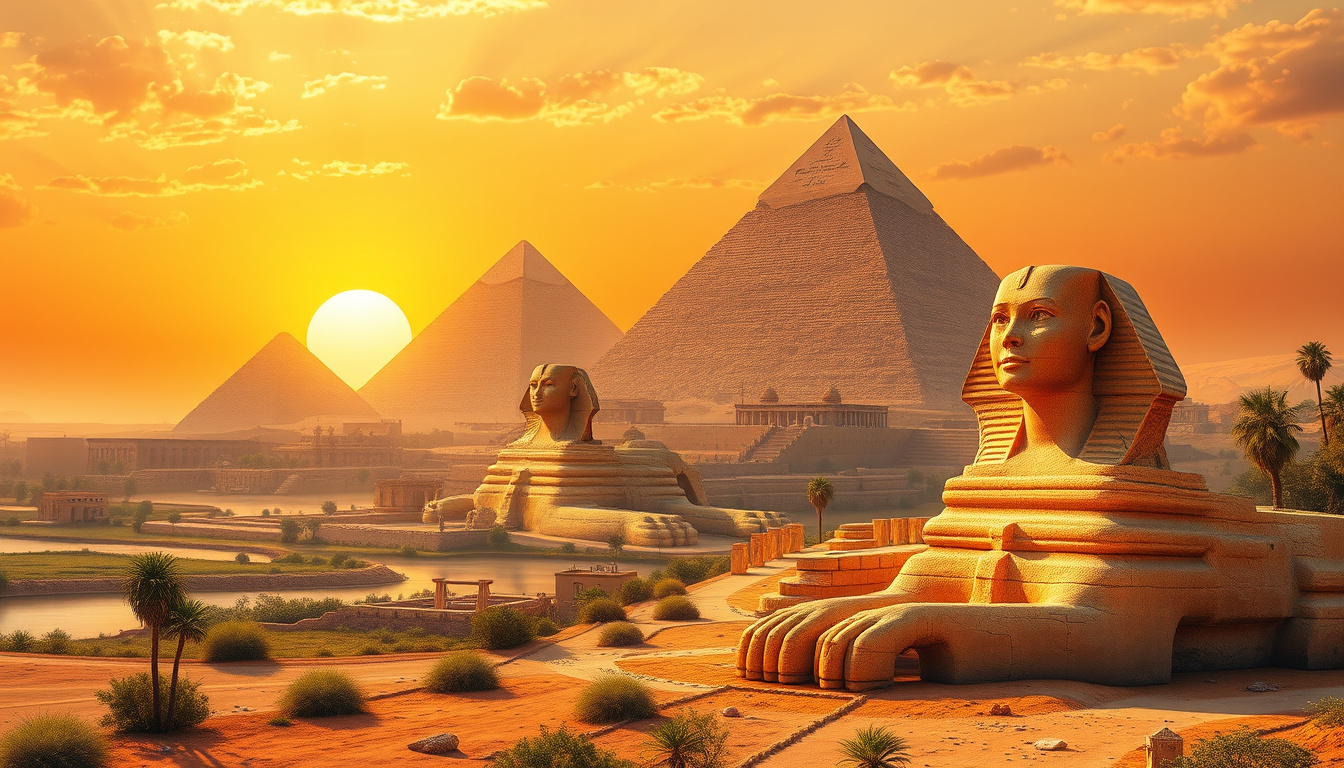
Ancient Egypt is one ancient society. It lasted for near 3000 years. Land, people, and gods joined to make its life. Its past stays with us even now.
The Nile River: The Lifeblood of Ancient Egypt
The Nile flows in Egypt. It floods each year. It leaves rich soil on the banks. This soil gives farms plenty to grow. Farmers use basin irrigation. Flood water fills low land and then helps wheat, barley, figs, pomegranates, and melons grow. The river moves timber, gold, and other goods. Gold shows wealth and power. Egypt gathered food with little toil. People then built temples and pyramids. The Nile gave Egypt a calm view of life and the next world.
Periodizing Ancient Egyptian History
Scholars split Egypt’s past into three parts. They call these parts the Old Kingdom, the Middle Kingdom, and the New Kingdom. In between, Egypt faced breaks and weaker times.
Old Kingdom (c. 2649–2152 BCE): The Age of Pyramids and Divine Kingship
The Old Kingdom was a bright time in Egypt. Pharaohs ruled as gods. Their rule was steady like the Nile. People built huge tombs to mark the journey of a ruler toward being like a god. Workers came from the common people. The story that enslaved Hebrews built the pyramids does not hold true. Pharaoh Khufu built the Great Pyramid. Pharaoh Khephren built the pyramid that has the sphinx. These works showed strong state power.
Middle Kingdom (c. 2040–1640 BCE): Restoration and Religious Change
Egypt met hard times with drought and internal strife. A king from Nubia brought Egypt back as one state. In this time, a hidden god named Ammun appeared. He later joined with the sun god Ra to form an important union. Soldiers then moved farther into Nubia. Groups such as the Hyksos came with bronze weapons and chariots. Egypt took in some of these new ideas. The state learned and changed with new skills.
New Kingdom (c. 1550–1070 BCE): Empire and Expansion
The New Kingdom was a time of far-reaching rule. Egypt crossed its river valley to gain new lands. Pharaoh Hatshepsut was a rare woman king. She focused on trade and keeping peace. Other kings chose to fight in wars. Egypt met powers like the Assyrians, Persians, and later Greeks led by Alexander. Pharaoh Akhenaten changed the state’s way of worship by giving strong weight to the sun disk god Aten. Soon after, Egypt went back to many gods. King Tutankhamen, a young ruler, helped put the old ways back. His tomb was found nearly intact in 1922. This find gives us a close look at burial customs and beliefs about life after death.
Religion and Culture: The Sun, Magic, and Afterlife
Gods were part of every day in Egypt. People prayed to Ra, Ammun-Ra, Osiris, Isis, and Horus. The Eye of Horus served as a sign to keep danger away. Magic, charms, and the power in living things joined in daily life. Cats were held as sacred animals. Egyptians saw the next world as a calm life. They placed food, small gifts, and charms in tombs for help on their journey. Writing held a key role in keeping order. Hieroglyphs filled temple walls and big stone words, while a simpler demotic script recorded daily needs. Their record keeping was smart and clear.
Legacy and Influence
Egypt lives on in its art, rules, and beliefs. Its statues, pyramids, and texts still stand. King Tutankhamen’s fame grew after his tomb was found. His brief rule contrasts with centuries of deep tradition. Egypt shows how land and strong order can last through time.
Frequently Asked Questions (FAQs)
Q1: Why was the Nile River so important to Ancient Egypt?
A1: The Nile’s floods brought rich soil. This rich soil fed farms. The river helped with trade and travel. It shaped daily life in Egypt.
Q2: How were the pyramids built and who built them?
A2: Many workers built the pyramids. They came mostly from the common people. The pyramids served as tombs and signs of royal power.
Q3: What did Pharaoh Akhenaten try in religion?
A3: Akhenaten focused on the sun god Aten. His change broke the old ways of worship. Not long after, old beliefs came back.
Q4: How did Ancient Egypt last so long?
A4: Egypt’s dry lands kept foes at bay. The Nile fed the land. Kings and deep faith kept order through ages.
Q5: Who was King Tutankhamen and why is he famous?
A5: King Tutankhamen was a young king. He brought back the way of the old gods. His tomb, found in 1922, shows us much about the past.
Q6: What role did women play in Egyptian society?
A6: Women held property and worked many jobs. Queen Hatshepsut rose to be a king. This shows that women could hold great power.
Q7: How did new weapons change Egypt?
A7: New tools like bronze arms and chariots strengthened armies. These changes affected wars and power struggles.
Conclusion
Ancient Egypt shines as an old land of deep faith and grand stone work. Its rich soil, strong rulers, and belief in gods and the next world lasted for nearly 3000 years. Its story shows how land and gods shape a people. The pyramids still stand. They call us to learn more about Egypt’s life and art.