
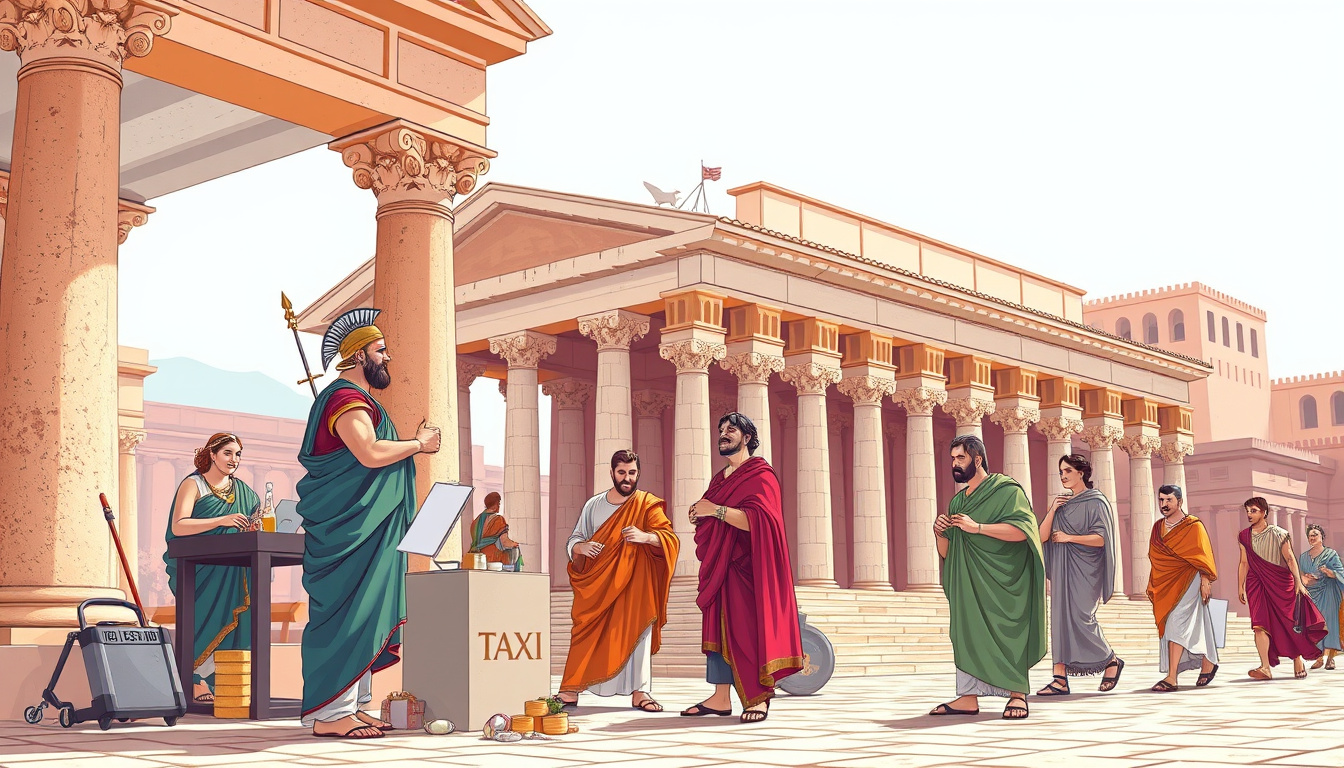
The ancient Roman Empire, although renowned for its military might and expansive territories, presented a complex and often challenging fiscal landscape for its inhabitants. While citizens of Rome enjoyed certain privileges such as subsidized grain and free baths, the majority of the empire’s population outside the capital received scant benefits aside from legal protections and military security. This article delves deep into the tax and tariff systems of Ancient Rome, exploring their origins, evolutions, regional disparities, and the broader socio-economic impacts on Roman society.
Early Roman Taxation: From Republic to Empire
Taxation in the Early Republic
In its early days, the Roman Republic’s tax structure resembled that of the Greek city-states, where direct taxation was generally minimal for citizens. Much like lower and middle-class Athenians who were exempt from direct taxes but undertook civic responsibilities known as liturgies (such as funding public performances or outfitting warships), early Romans contributed indirectly to public services. The Republic primarily relied on:
- Temporary property taxes levied to support military campaigns.
- Revenue from public land sales and leases.
- Indirect taxes such as a 5% duty on freed slaves.
This system was manageable because of Rome’s limited territorial extent and its focus on citizen duties rather than systematic taxation.
The Impact of Conquest and Wealth Influx
The conquest of the Hellenistic kingdoms in the 2nd century BCE introduced a vast influx of wealth to Rome, enabling the Republic to abolish direct taxation on citizens across Italy. Instead, Rome imposed land taxes and poll taxes in newly acquired provinces. These taxes were often associated with abuses as tax collection was outsourced to private contractors known as Publicani, who tended to prioritize profit over fairness, excessively burdening provincial populations.
Augustus’ Reforms: Centralizing and Rationalizing Taxation
Recognizing these abuses and the need to support a standing army, Emperor Augustus initiated reforms to create a more orderly taxation system:
- Restricted Publicani to customs duties.
- Transferred tax collection responsibilities to local provincial elites.
- Introduced a 4% sales tax on slaves and a 5% inheritance tax.
- Instituted regular censuses to maintain updated tax registers.
Notably, Augustus did not impose a uniform tax system across the empire. The Romans adopted a pragmatic policy of retaining existing regional tax systems in conquered territories, leading to significant variation between provinces and even cities. Some communities gained exemption from taxes in recognition of loyalty or exceptional service.
Modes of Tax Payment: Cash, Kind, and Quirks of Local Economy
Taxes could be paid either in cash or in kind, reflecting local customs and state requirements. Examples of local peculiarities include:
- The Sirenes, who paid taxes in sulfium, a plant prized as a nephrodisiac.
- The Frisii, who paid in oxen.
Land tax rates varied widely, ranging from one-seventeenth to one-fifth of the harvest, with fertile farmland taxed more heavily than pasture.
Egypt: The Most Heavily Taxed Province
Egypt, a vital granary for Rome, faced relentless taxation:
- All males between 14 and 60 were subject to poll taxes.
- Even the deceased were taxed for the year they died.
- Farmers surrendered portions of grain and other crops.
- Tradesmen faced taxes on goods.
- Additional levies supported maintenance of canals, temples, and hospitality for officials.
During the reign of Marcus Aurelius, a single modest town in Egypt, Coranis, was subject to over 40 different taxes, rents, and fees.
Provincial City Taxes and Trade Tariffs
In addition to imperial taxes, many provincial cities imposed their own customs duties, often ranging from 2% to 5% on trade between Roman provinces. Goods entering the empire from outside faced tariffs as high as 25%, providing significant revenue but also complicating trade.
The 3rd-Century Crisis and Diocletian’s Reforms
The financial turmoil of the 3rd century CE prompted Emperor Diocletian to overhaul the Roman tax system:
- Established land and poll taxes assessed via standardized units of land area and population.
- Instituted regular censuses to maintain accurate tax rolls.
- Levied taxes mostly in kind to address rampant inflation.
Estimates suggest the Roman empire’s tax revenue amounted to around 5% of its GDP—comparable to 18th century France. While this may seem modest today, for many Romans living at or near subsistence levels, meeting tax obligations was an immense and often untenable burden.
Socio-Economic Impact of Roman Taxation
The Burden on the Poor
Most Romans were agrarian peasants who produced just enough to sustain themselves and small surpluses for taxation. Several factors exacerbated their hardships:
- Tax rates were regressive: the same percentages applied to rich and poor alike, disproportionately impacting the less affluent.
- Tax collectors and financial officials were notoriously corrupt, often demanding bribes or inflated payments, doubling citizens’ obligations.
- Natural disasters and poor harvests could wipe out surpluses, leaving peasants unable to meet tax demands with scant relief.
- Some families fled to deserts to escape oppressive taxation, especially in Egypt.
Wealth and Influence of the Elites
In stark contrast, wealthy elites paid relatively modest taxes proportional to their wealth. The relative peace and prosperity during imperial times allowed local elites to amass wealth and invest heavily in public infrastructure. Many of the grand cityscapes across Roman territories—from Londinium (London) to Ephesus—stand testament to this wealth, sustained indirectly by the tax system that often marginalized the common populace.
Conclusion
The fiscal framework of Ancient Rome reveals a complex interplay between imperial ambitions, regional diversity, and socio-economic realities. While the empire maintained a relatively low tax rate by modern standards, the harshness of enforcement, regional disparities, and systemic corruption imposed a heavy burden on the majority of its population. Nevertheless, the tax system enabled Rome to sustain its military and administrative infrastructure over centuries, leaving a lasting architectural and cultural legacy. Understanding these fiscal dynamics provides valuable insights into how ancient societies balanced governance, economic productivity, and social equity, often with profound implications for their stability and longevity.
Frequently Asked Questions (FAQ)
Q1: Were Roman taxes uniform across the empire?
A1: No, Roman taxes were highly varied. The empire retained existing local tax systems after conquest, leading to different taxes and rates in various provinces and cities.
Q2: How were Roman taxes collected?
A2: Taxes were collected via state officials or private contractors called Publicani, with collection sometimes delegated to local elites. Payments could be made in cash or kind, depending on regional customs.
Q3: Why was Egypt the most heavily taxed province?
A3: Egypt’s agricultural productivity and strategic Nile resources made it essential for Rome’s grain supply. This importance led to heavy taxation covering various goods, services, and even people.
Q4: Did the Romans have tax relief during hardships?
A4: There were occasional remissions during natural disasters or droughts, but these were rare and tax collectors often lacked compassion.
Q5: How did Roman taxation compare to modern systems?
A5: Roman tax revenue was about 5% of GDP, lower than most modern states. However, taxes were regressive and harder for common people to pay, lacking modern welfare mechanisms.
By unpacking the details of ancient Roman taxation, we uncover a nuanced picture of empire management and social structure—one shaped by pragmatism, inequality, and the persistent challenges of governance in an expansive and diverse realm.