
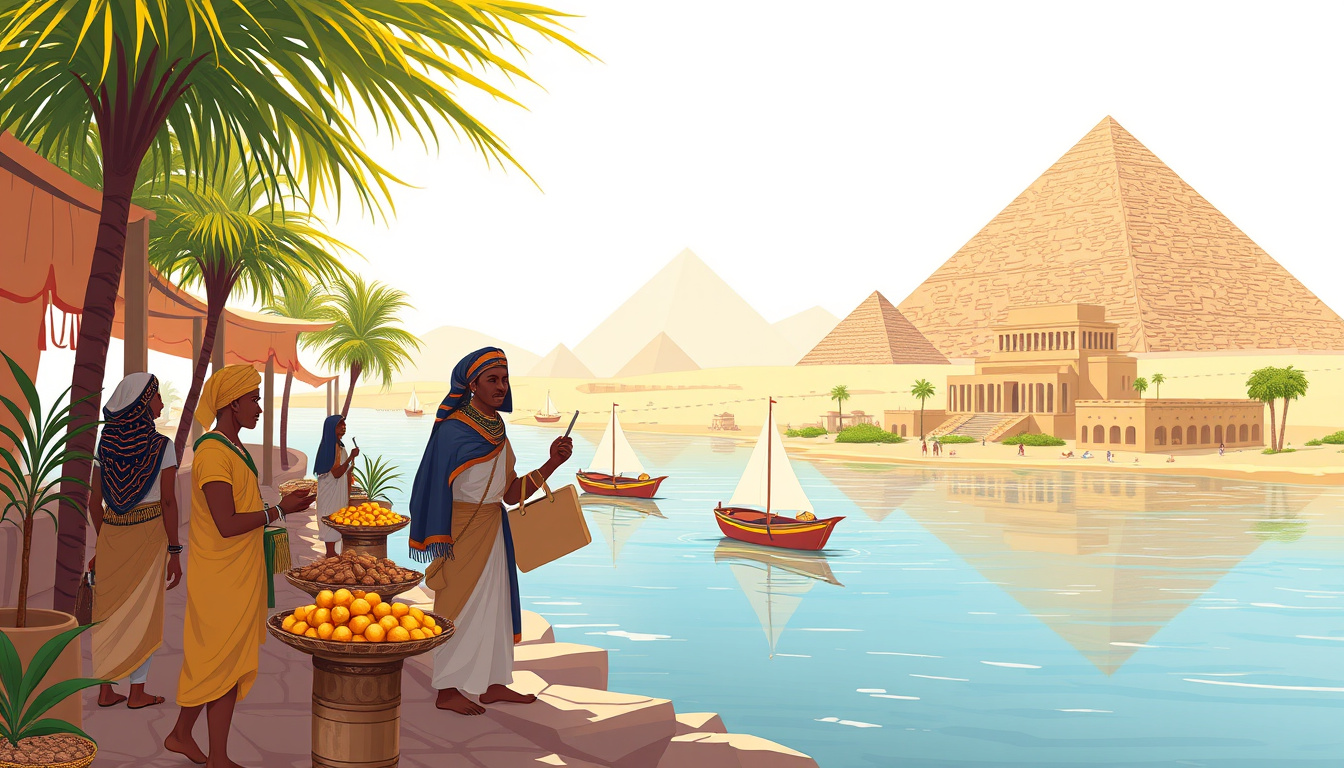
Exploring the Wealth and Trade of Ancient Egypt: A Journey Through Its Economic Marvels
Ancient Egypt is renowned worldwide, not only for its grand monuments like the pyramids but also for its exceptional economic system that supported one of the longest-lasting civilizations in human history. Spanning thousands of years, the Egyptian economy evolved to become a pivotal example of early human resource management, trade, and centralized planning. This article delves into the economic marvels of ancient Egypt, exploring how its wealth was amassed, managed, and circulated through trade and agriculture.
The Longevity and Significance of Ancient Egypt’s Economy
Ancient Egypt was among the first major human civilizations, preceded only by early societies such as Mesopotamia. What sets Egypt apart is its extraordinary longevity. The time between the construction of the pyramids, around 2500 BCE, and the death of Cleopatra in 30 BCE spans more than two millennia, a historical breadth difficult to comprehend. Remarkably, the fall of ancient Egypt is closer in time to the construction of the modern Burj Khalifa than to the pyramids themselves.
This vast timeline reveals how the Egyptian economy was not a static entity but a narrative of growth and adaptation spanning millennia. It serves as a recorded journal illustrating how a society directly confronted and addressed the core challenge of economics: allocating limited resources among unlimited human desires.
The Central Economic Problem and Egypt’s Solution
Economics fundamentally revolves around the problem of scarcity — the reality that resources are finite, while human wants are boundless. Modern economies are complex, filled with layers of financial systems including inflation management, debt, derivatives, and speculative investments. Ancient Egypt, however, provides an unembellished glimpse into the basics of economics without these modern complexities.
To manage their economy, Egyptians implemented a system akin to centralized planning. This approach was largely designed to ensure the efficient allocation of resources, especially agricultural produce, which was the backbone of the economy. The Egyptian model combined strict hierarchical governance with some personal liberties that allowed for individual economic choices within this planned structure.
Agriculture: The Cornerstone of Egyptian Wealth
Agriculture was the heart of ancient Egypt’s economy, making it an agrarian society in the truest sense. Most Egyptians were farmers who labored mainly to grow enough food to sustain the population. The fertile banks of the Nile River were crucial, as annual floods replenished the soil, enabling abundant harvests.
Most farms were state-owned and managed through temples lining the Nile. These temples served multifaceted roles as centers of worship, commerce, and local government administration. The governance was centralized and closely tied to religious institutions, with the Pharaoh at the pinnacle as both a divine and political leader.
Food, especially grain, was collected and stored in temple granaries. Workers were compensated with grain, serving as both wage and currency. A typical laborer could earn approximately 200 kilograms of grain monthly, depending on skill and harvest success. This system ensured that resources were carefully distributed to fulfill the needs of various segments of society.
The Pharaoh’s Role: Divine Ruler and Economic Overseer
The Pharaoh was not just an ordinary king but a god on earth whose favor was believed essential to the prosperity of Egypt. The annual success or failure of the harvest was interpreted as a direct reflection of the Pharaoh’s standing with the gods.
This divine authority supported a stable yet rigid societal hierarchy with the Pharaoh at the top, followed by officials such as the grand vizier, priests, and scribes, down to farmers and laborers. While this hierarchy may seem oppressive from a modern perspective, evidence points to a surprising degree of liberty within the system.
For instance, ordinary citizens—even peasants—held the legal right to challenge higher officials, such as the grand vizier, demanding justice and compensation if wronged. Such recourse underscores a level of social mobility and fairness rare for the time and even notable by today’s standards.
Trade and Currency: Grain as a Medium of Exchange
The Egyptian economy also incorporated elements of trade that resemble early market systems. Grain, beyond being a staple food, functioned as a form of currency. Goods such as cattle, clothing, and even wine were priced and traded in grain, based on standardized price lists.
While this system may appear rigid compared to modern free markets, it allowed Egyptians to make choices about which needs to satisfy and what to forgo, helping address the fundamental issue of scarcity. People could engage in barter-like transactions facilitated by grain, enabling a basic but effective system of trade.
Multifunctional Temples: Centers of Economy, Government, and Religion
Temples in ancient Egypt were not only religious hubs but also pivotal economic and administrative centers. They collected surpluses, stored them, and redistributed resources across regions. This centralization ensured stable food supplies during lean years and provided laborers with consistent wages.
Moreover, temples functioned as local government offices, enforcing laws and overseeing the community’s welfare. This unique blend of religion, governance, and economics under one roof created an integrated society where each aspect reinforced the others, contributing to the civilization’s stability.
Summary: The Economic Legacy of Ancient Egypt
Ancient Egypt’s economy was a sophisticated blend of centralized control, religious governance, agricultural productivity, and emergent market dynamics. Through meticulous management of resources, the Egyptians created a prosperous civilization that thrived for millennia. Their system provides modern scholars with invaluable insights into the foundational dynamics of economies, stripped of modern financial complexities.
Frequently Asked Questions (FAQ)
Q1: What was the main economic activity in ancient Egypt?
A1: The primary economic activity was agriculture, especially farming along the Nile River, which was vital for producing the grain that fed the population and served as currency.
Q2: How did the Pharaoh influence the economy?
A2: The Pharaoh was considered a divine ruler whose favor dictated the success of agricultural yields and therefore the prosperity of the entire economy. The Pharaoh also centralized control, overseeing resource distribution.
Q3: What role did temples play in the economy?
A3: Temples acted as centers for storing and redistributing food, managing labor wages, facilitating local governance, and serving religious functions, making them central to daily economic life.
Q4: Was there personal economic freedom in ancient Egypt?
A4: Despite a strict social hierarchy, many Egyptians had economic liberties, such as trading goods with grain, the right to seek legal recourse against officials, and choices in using their wages.
Q5: How did ancient Egyptians conduct trade?
A5: Trade was usually conducted through barter systems using grain as currency, allowing people to exchange goods like cattle, clothing, and wine according to fixed price lists.
Conclusion
An exploration of ancient Egypt’s economy reveals a civilization that deftly balanced centralized planning with individual freedoms to address the eternal economic problem of scarcity. Agriculture sustained a society that organized itself around religious and governmental institutions, ensuring a stable supply of goods and maintaining social order. Trade, wages, and legal rights within this system added layers of personal and economic agency that supported one of history’s longest-lasting civilizations. Understanding these ancient economic marvels not only enriches our historical knowledge but also provides timeless lessons about resource management, social structure, and economic governance that remain relevant today.